
 Contact us


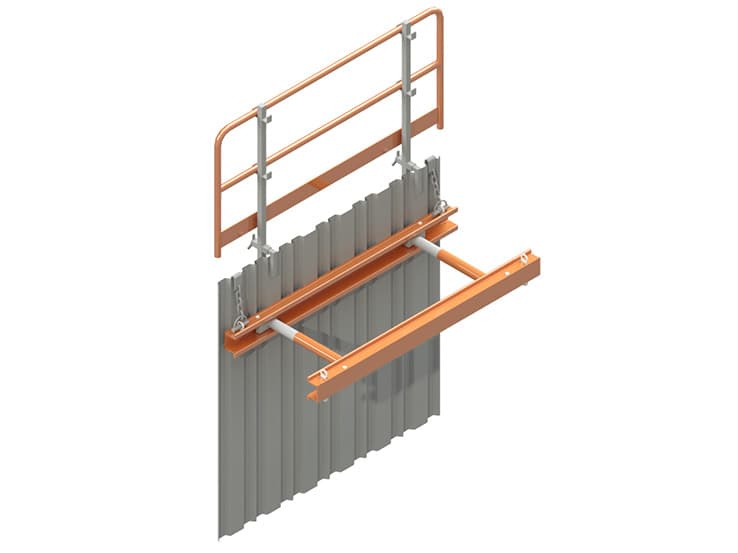
Aluminium Waler Frame Systems
A light alloy waler frame for bracing trench sheets around live services
- Rails from 1.5m to 5m
- Light enough to handle by hand
- Hydraulics run on water, not oil
- Fast lead times
- Competitive rates
An aluminium waler frame (also called a waling beam or horizontal waler system) braces trench sheets around an excavation from the inside, holding back the ground while your team works. Because the sheets are placed individually around the frame, gaps can be left exactly where pipes or cables cross the trench, which makes walers the system of choice where a trench box can't be used because services are present.
The frame is built from light alloy waler rails, from 1.5m up to 5m long, braced apart by hydraulic struts. A rail weighs between 16.5kg and 55kg and the hydraulic ram 11kg, so the parts can be carried and assembled by hand, in the excavation if needed. The pump runs on water, with no hydraulic oil to spill into the ground. Shorter rails are popular with utility companies, and the system is often chosen for city centre excavations where disruption has to be kept to a minimum.
Applications
- Shoring trenches where gas, water or telecoms services cross
- Utility connections and repairs
- City centre and highway excavations
- Manhole and chamber construction
- Deeper trenches, with frames installed at multiple levels
End bearers
End bearer rails can be used to close the short ends of the frame, so the trench sheets are supported on all four sides of the excavation rather than just the two long faces. We stock three sizes, adjustable in 75mm increments and fixed with pins and R-clips:
Installing a waler frame
The usual method is dig and push. The frame is assembled on the surface, pumped out to size and lowered into a shallow pit, then sheets are pushed around its perimeter using the rails as a guide. Excavation and sheet-driving then alternate, with temporary frames restraining the sheets, until the formation level is reached. For deeper excavations, frames are installed at two or more levels. The full sequence, including the pre-driving alternative, is in the user guide.
Safety points our engineers insist on:
- Never enter the excavation before adequate shoring is in place
- Work to a lift plan; the heaviest frame is 168kg, and hanging chains must not be used for lifting
- Inspect every component and the hydraulics before use, and reject anything damaged
- Install edge protection, safe access and a davit system where required
- Leave at least 100mm of extension on the rams so the frame can be retracted for removal
Get In Touch
For hire rates or advice on any of our waler frame systems, please contact your nearest depot.
FAQs
What is a waler in construction?
When should I use a waler frame instead of a trench box?
Are aluminium walers as strong as steel walers?
How deep can a waler frame excavation go?
What is a battered edge?
Do I need training to install a waler frame?
Waler Frame Dimensions and Limits
| Length | Permissible Load | Cylinder | Min Width | Max Width | Frame Weight |
|---|---|---|---|---|---|
| m | kN/m | m | m | kg | |
| 1.50 | 80 | 2no | 0.50 | 2.00 | 77 |
| 2.00 | 56 | 2no | 0.50 | 2.00 | 88 |
| 2.50 | 48 | 2no | 0.50 | 2.00 | 99 |
| 3.00 | 30 | 2no | 0.50 | 1.80 | 110 |
| 3.50 | 36 | 3no | 0.50 | 1.80 | 143 |
| 4.00 | 30.5 | 3no | 0.50 | 1.80 | 154 |
| 5.00 | 23 | 3no | 0.50 | 1.80 | 168 |
| 3 cylinders are required on rails 3.5m and above. | |||||
| Waler Frame weights assume max length strut @ 22kg each | |||||
Aluminium Waler Rail
| Permissible Moment | Moment of Inertia | Section Modulus | Weight |
|---|---|---|---|
| kNm | cm⁴ | cm³ | kg/m |
| 18 | 561 | 117 | 11 |
Component Weights
| Item | Weight kg |
|---|---|
| 1.5m Rail | 16.5 |
| 2.0m Rail | 22.0 |
| 2.5m Rail | 27.5 |
| 3.0m Rail | 33.0 |
| 3.5m Rail | 38.5 |
| 4.0m Rail | 44.0 |
| 5.0m Rail | 55.0 |
| Hydraulic Ram 500–820mm | 11.0 |
| Strut Foot | 3.1 |
| Extensions 0.1m–1.0m | 1.0–6.2 |
Strut centres = rail length − 0.72m. On three-strut frames, place the third strut centrally.
End bearer rails
| End bearer | Width (pin to pin) | Weight | Permissible load |
|---|---|---|---|
| Type A | 0.48m – 0.78m | 13kg | 60.5–80 kN/m |
| Type B | 0.73m – 1.26m | 16.5kg | 38.3–64.4 kN/m |
| Type C | 1.21m – 1.96m | 24kg | 20.8–39.8 kN/m |
One caution on loads: the end bearer and the waler rails are rated separately, and the weaker of the two governs the frame. Always check the permissible load of both against your Temporary Works Design, or ask our engineers to confirm it for you.
Related Products
Supplementary equipment for use with waler frames