
 Contact us


Temporary Works Design
Our in-house Civil and Structural Engineers can create bespoke schemes for excavations, propping and formwork – to BS 5975 standards
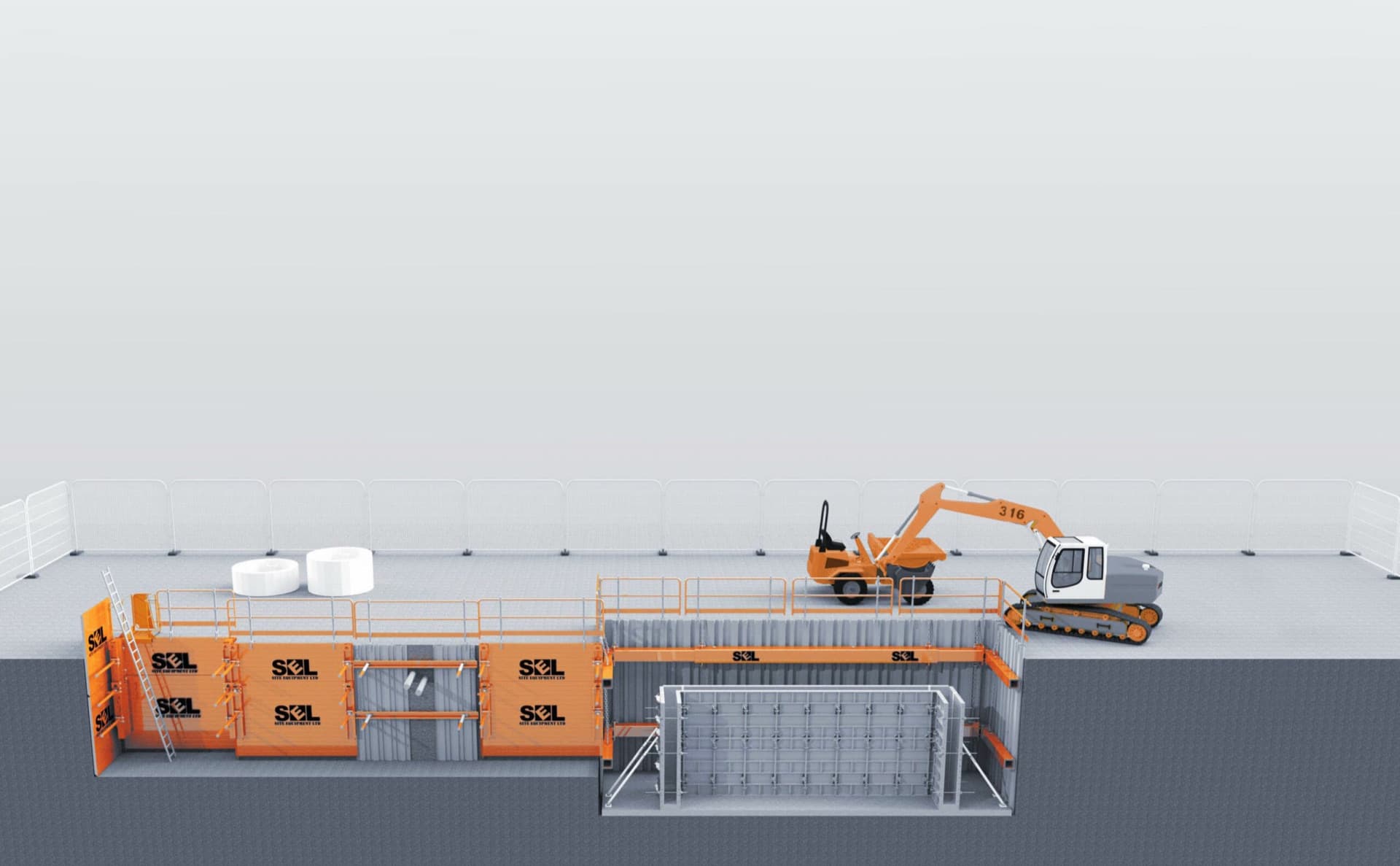
Equipment hire, sale, Temporary Works Design and technical support
Site Equipment Limited is a specialist provider of Temporary Works Design and equipment hire with over 50 years of experience. Whether you need straightforward equipment hire or a bespoke design from our in-house civil and structural engineers, we support excavation, propping and formwork projects across the UK.
Our in-house Civil and Structural Engineers can create bespoke schemes for excavations, propping and formwork – to BS 5975 standards

We regularly deliver across the UK from our depots in Bristol, Cardiff and London. We hold good availability and offer rapid lead times across our entire range
Every piece of equipment in our hire fleet is rigorously inspected, maintained and supplied with full, LOLER-compliant test certificates where applicable
View all our case studies to learn more about our engineering support and Temporary Works Design experience.
We operate to the highest safety standards. Site Equipment Limited is fully ISO 9001 certified and proudly accredited by leading industry bodies including the CPA and SafeContractor.
If you have a complex excavation or propping project coming up, get in touch to see how we can support it safely.





Temporary works are an engineered solution used to support or protect a structure during construction. They can hold up the sides of an excavation, support plant or provide access. In plainer terms, temporary works are what holds everything up while a permanent structure is built.
Temporary works are removed once the work they support is finished. Formwork is struck when the concrete has cured, props come down when the new beam takes the load, and excavation support is normally removed as the dig is backfilled.
Site Equipment has supplied and designed temporary works for over fifty years. Our in-house Civil and Structural Engineers have decades of experience with excavations, propping and concrete works throughout the UK. Simply contact us if you'd like a free consultation.
Temporary works can include:
Excavation support and shoring retain the sides of a dig, using trench sheets, boxes and bracing to stop the ground moving while people work below.
Propping and needling hold up structures, carrying the weight of a building while a wall beneath it is opened up or taken out.
Falsework and formwork hold concrete, shaping the pour and supporting it until it has cured.
Other examples of temporary works include access scaffolds, temporary bridges, haul roads and crane platforms, although these last two are often left in the ground and built into the permanent works.
Temporary works are crucial both for safe working conditions during construction and for the safety and integrity of existing structures, utilities and ground.
The loads involved leave no margin for error. A cubic metre of soil can weigh more than 1.5 tonnes, and the HSE's position is that no ground can be relied upon to stand unsupported in all circumstances. Unshored trench sides can come away without warning, causing a danger to anyone working below, whereas badly or insufficiently supported buildings can crack or even collapse.
Here at Site Equipment we have decades of engineering experience in the safe deployment of temporary works, and safety and stability are at the heart of everything we do.
Permanent works are the finished structure, the foundations, walls, drainage and roads that stay behind when the site closes. Temporary works hold everything in place while that structure is built, and they are often formed from equipment that is removed at the end of construction.
Permanent works are designed to the Building Regulations and the Eurocodes, for the working life of the asset. Temporary works are designed to BS 5975, for the weeks or months they need to stand. They often have different designers as well, with an architect or structural engineer responsible for the permanent structure and a temporary works engineer for the scheme that allows it to be built.
The line between the two can blur. Piles sometimes go in to support an excavation and then stay as part of the finished structure. Where that happens, the works must meet the permanent works standards for capacity and durability as well as the temporary standards.
Either way, the level of care does not change. The HSE expects the same attention in the design and construction of temporary works as in the permanent works they make possible.
Propping means using a prop to carry or resist a load between two stable points. A prop may stand vertically under a slab, run horizontally to keep formwork in position, or be installed at an angle against a wall.
Shoring is a broader term. It means providing temporary support to something that could otherwise move, collapse or become unstable. This could be the face of an excavation, a wall or façade, or a building that is being altered or repaired. Dead shores, raking shores and trench shoring are all forms of shoring, and they are commonly built using props.
A useful way to think about it is:
In groundworks and civil engineering, shoring usually refers specifically to excavation support systems used to keep trenches and excavations stable while work is carried out.
You can learn more about propping and excavation support.
Temporary works engineering is the design of the shoring, propping, formwork and falsework a job needs while the permanent structure is built. A temporary works engineer works out what support the job needs, sizes it, and produces the drawings and calculations the site team builds to and inspects against.
The design has to account for the ground conditions, any groundwater, surcharge from roads, plant and neighbouring buildings, and the order the contractor plans to work in. The same excavation in different ground needs a different scheme.
BS 5975 is the British Standard for temporary works. It sets out how a design is prepared, checked and controlled, including who is competent to check it and how thorough that check needs to be.
Our in-house Civil and Structural Engineers have decades of experience behind them, and can take the headache out of temporary works engineering. Tell us about your job and we will work out what it needs, whether that is excavation support, propping or a full Temporary Works Design.
Every item of temporary works needs a design behind it, but that design is not always a bespoke one. On straightforward work it is often the manufacturer's standard specification, so picking a trench box from a table and using it within its stated limits already counts as a design.
Checking that the standard design suits your site is not optional. Someone still has to look at the ground, the depth, any water and what sits alongside the dig, then confirm the equipment is right for it.
A bespoke design becomes necessary once the job moves away from standard conditions, such as work close to existing buildings, refurbishment or demolition, awkward geometry, poor ground, or surcharge from roads and plant. The HSE's position is that in all but the simplest situations a design including calculations will be needed.
If you are unsure which side of that line your job falls on, ask an engineer before the dig opens rather than after. Ours are happy to talk it through, and can produce the Temporary Works Design if the job needs one.
We deliver throughout the UK from regional depots in Bristol, Cardiff and London.
We carry a wide range of equipment across all our depots. We offer fast lead times and competitive rates, and our depots stay open longer than most.
To find out how we can help you and how soon we can deliver, simply contact your nearest depot.

Our team is friendly, knowledgeable and ready to consult. We offer no-obligation site visits, fast delivery and competitive rates. Simply fill in the form and we'll be in touch.
You can also give us a call at any time.