
 Contact us

Pipe Towing Heads
Pipe towing heads from 32mm to 355mm, connecting new PE pipe to the pulling equipment
- Sizes from 32mm to 355mm
- Standard or mud-tight versions
- Matched to your pipe diameter and SDR
- Available for sale or hire
- Nationwide delivery
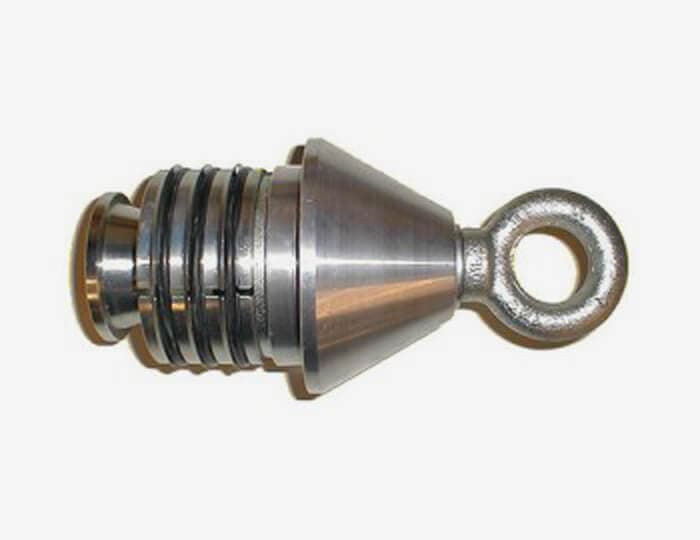
A pipe towing head is the connector between the pulling equipment and the new PE pipe going in. It fits into the end of the pipe, and the rig pulls on the head rather than on the pipe wall itself, so the load is taken where the pipe can carry it. We sell and hire towing heads from 32mm to 355mm, in standard and mud-tight versions.
How a Towing Head Connects to the Pipe
The head goes into the open end of the PE pipe and its grippers bear against the inside wall. The harder the rig pulls, the tighter they bite, so the connection holds for the length of the pull. At the other end is the eye the bursting rod, the mole or the winch rope shackles onto.
Pulling on a bare pipe end is what a towing head exists to avoid. Take the load on the pipe wall and it stretches, necks and can be damaged beyond use before the pull is finished.
Standard or Mud-Tight?
A standard towing head suits general pipe pulling and trenchless installation, where the bore is reasonably clean and a bit of ingress does not matter.
A mud-tight head seals the pipe end as it pulls, so the bore stays clean through ground water, drilling mud and slurry. Take the head off at the far pit and the pipe is clean inside, which saves cleaning it out before you commission it. Ask for mud-tight if the pipe you are installing has to be clean when it arrives.
Choosing the Right Towing Head
Two things decide which head you need: the outside diameter of your pipe, and its SDR. SDR is the ratio of that outside diameter to the wall thickness, so two 90mm pipes at different SDRs have different bores, and a head sized for one will not seat properly in the other.
Tell us the pipe diameter and the SDR and we will match the head to it.
Where the Towing Head Sits in the Job
A towing head is never the whole job. It is the last link in an assembly, and which assembly depends on the method.
Pipe bursting with a Grundoburst runs rod, then bursting head, then expander, then towing head, then the new pipe. The rod pulls the lot back through the old pipeline in one pass.
Installing with an impact mole runs mole, then towing head, then the new pipe or duct, so the product follows the tool through the bore it has just made.
Pulling with a Grundowinch runs rope, then towing head, then the pipe, for sliplining and for drawing PE pipe into an open bore.
Common Questions
What is a pipe towing head?
Is a pulling head the same as a towing head?
How do I choose the right size towing head?
What is the difference between a standard and a mud-tight towing head?
Can a towing head be used with an impact mole?
What does SDR mean when ordering a towing head?
Do you sell towing heads as well as hire them?
Buy or Hire Pipe Towing Heads
Tell us the pipe diameter and SDR you are working with and we will match the head to it. We offer towing heads for sale or hire with good stock availability, fast lead times and delivery nationwide. For towing heads or any other products in our Trenchless Technology range, please contact your nearest depot.
Towing Head Sizes
Towing heads are held to suit standard PE pipe outside diameters. Each size is matched to the SDR of the pipe it goes into, so tell us both when you order. Larger sizes and non-standard SDRs can be sourced on request.
32mm, 40mm, 50mm, 55mm, 63mm, 90mm, 100mm, 105mm, 110mm, 125mm, 140mm, 160mm, 180mm, 200mm, 225mm, 250mm, 280mm, 315mm and 355mm.
Standard and mud-tight versions are available across the range.
Related Products
The equipment that pulls the towing head, and the pipe behind it