
 Contact us


Standard Manhole Box Installation Guide
How to assemble, install and remove a Standard Manhole Box, the heavy-duty four-sided box we hire and sell for installing large manhole rings, pumping stations and interceptor tanks.
The box is assembled flat on timber bearers with the manhole profile pinned on, stood upright with a 4-leg chain and lowered into a pre-excavated trench up to 1.25m deep, then dug and pushed down to depth in steps of up to 500mm. Under the site conditions listed below, the maximum excavation depth is 5.3m. You remove the box in lifts of no more than 500mm, backfilling inside it as you go.
If you'd like a printable copy, download the Standard Manhole Box User Guide (PDF). For full specifications, see the Standard Manhole Box product page.
Box Details
| Box Length | Panel Height | Box Weight Range |
|---|---|---|
| 2.50m | 2.6 Base | 2380 - 2916kg |
| 2.50m | 1.4 Top | 1542- 1810kg |
| 3.00m | 2.6 Base | 2635 - 3171kg |
| 3.00m | 1.4 Top | 1686 - 1955kg |
| 3.50m | 2.6 Base | 2880 - 3416kg |
| 3.50m | 1.4 Top | 1832 - 2100kg |
| 4.00m | 2.6 Base | 3120 - 3656kg |
| 4.00m | 1.4 Top | 1977 - 2245kg |
| 4.50m | 2.6 Base | 3650 - 4186kg |
| 4.50m | 1.4 Top | 2362 - 2610kg |
Installation Sequence
1. Preparation
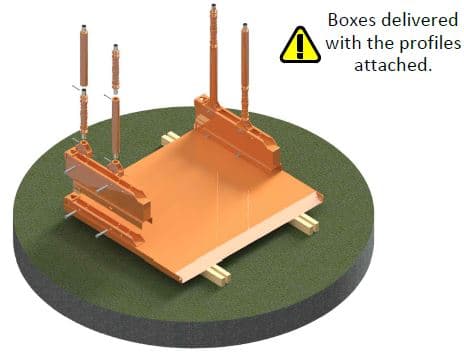
Lay the Manhole Box panel down on a level surface on suitable timber bearers using the 4-Leg chain provided.
Connect the Manhole Profile using 2no 40Ø Pins & R-Clips.
Connect the Spring Spindle Holders using a 40Ø Pin & R-Clip. Connect the Adjustable spindle and appropriate extension pipes using 20Ø Pins & R-Clips.
Ensure that the lower Spindles are extended by 30-50mm more than the top Spindles.
2. Fit second panel
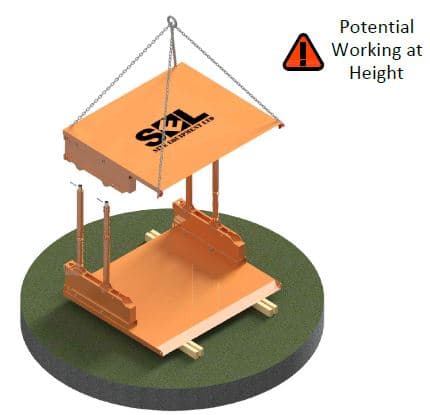
Lower the opposite panel onto the spindles using the 4-Leg chain. Chain hooks to be secured to the handling points at the upper and lower ends of each side.
Secure to spindles using 20Ø Pins & R-Clips. Do not remove slack in the chains until all the spindles are secured.
3. Lower into trench
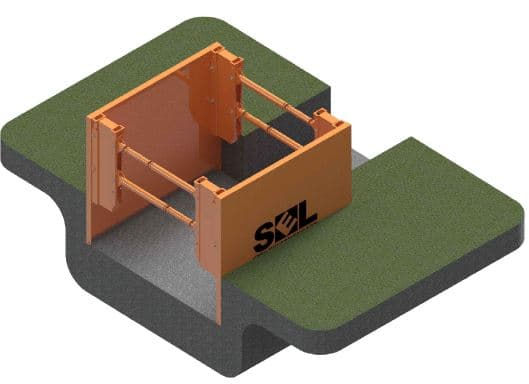
Lift the box into an upright position using the 4-Leg chain secured through the upper handling points. Lower the box into a pre-excavated trench (max. 1.25m - soil stability assessed by the Contractor).
Fill and compact any gaps outside the box.
4. Excavate and push down
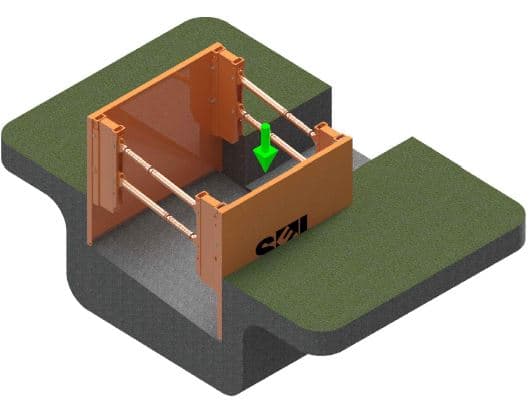
Excavate within the box up to 500mm deeper. Using the excavator bucket, push the top of the panel down.
Do not batter the box or push the spindles.
Note that the spindles must not exceed +/-8° rotation.
Do not enter the trench until the box is fully installed.
5. Repeat on the other side
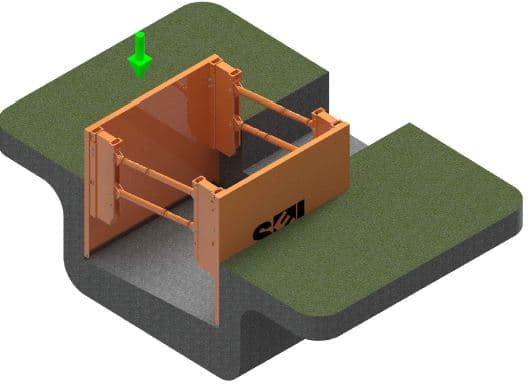
Repeat stage 4 on the other side of the box and alternatively Dig & Push the box to the required depth.
Smaller incremental steps are better for the shoring.
6. Add top box
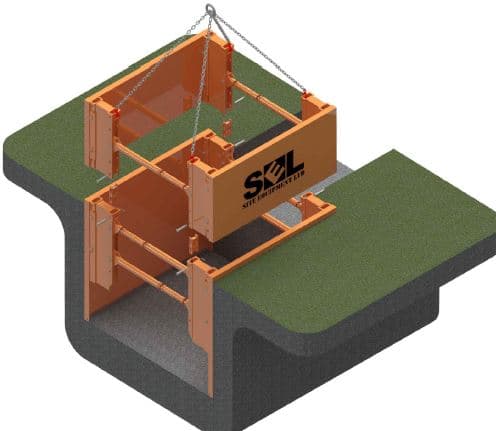
Where required, lower on a top box (assembled similar to stage 1) and connect using the Box Connection Unit and 40Ø Pins & Clips in each corner (see ).
Continue the Dig & Push sequence as before.
7. Edge protection and end closure
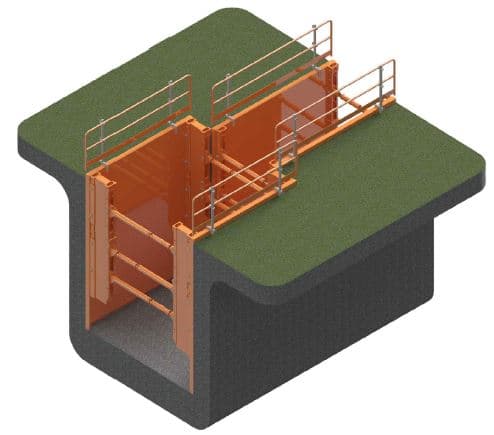
Install suitable edge protection and access where required. Ensure that the open end of the excavation is battered to a safe angle as determined by the Contractor or closed with suitable end closure (see below).
Removal
The removal of the boxes should be performed sequentially. Once the permanent works are installed, the contractor should backfill inside the box in layers not exceeding 500mm.
Once the backfill is compacted to the Permanent Works design standard, the box can be lifted by a maximum of 500mm or +/-8° Spindle angle.
Continue the removal of the box sequentially in the reverse of the installation procedure until the boxes can be removed completely.
Site Specific Considerations
A Trained and Competent person must assess both the site and ground conditions.
The boxes must be installed using the Dig & Push method in temporarily unstable ground. In stable and self supporting ground the boxes can simply be lifted into a pre-excavated trench. If any of the following ground conditions are anticipated / encountered, please contact SEL for advice as this box system may be limited in depth or suitability.
- Unknown Ground
- Soft / Very Soft CLAY
- Very Loose SAND
- Silt
- Very Loose GRAVEL
- Peat
Careful consideration must be given to employing boxes in water bearing soils or in the vicinity of watercourses.
If anything beyond the following site conditions are anticipated / encountered please contact SEL for advice.
- Maximum excavation depth of 5.3m
- Maximum excavation duration <12 weeks
- Plant and machinery <30T operating near dig.
- No Structures located within 5.3m of dig.
- Adjacent slopes not in excess of +/- 1 in 10.
- No Services cross the path of the boxes.
- Deflection sensitive services not located within 4.0m of the dig.
- A live railway is not located within 7m of the edge of the excavation.
- Public Highway not located within 7m of the edge of the excavation.
- Suitable plant is available to lift and manoeuvre the selected box.
Residual Risks
The following residual risks must be addressed in the Contractors RAMS:
- When lowering the opposite panel onto the spindles, ensure operatives hands are low down on the spindle (Stage 2).
- Ensure operatives hands are kept clear of pinch points when lowering the top box onto the base box (Stage 6).
- When removing the chains from the opposite panel, consider potential working at height risks (Stage 2).
- Locate all potential services prior to excavation in accordance with NRSWA Regulations.
- The excavation may be classified as a confined space. The Contractor must assess this risk and provide suitable gas detection and rescue equipment where appropriate.
- If a spindle is struck accidentally by an excavator, inspect immediately. If damage is visible, remove the box from the trench and replace the spindle following the steps identified above.
Do's and Don'ts
- Contact Site Equipment if unsure about any element of this document.
- Inspect all components to ensure that there are no signs of damage and that they are installed correctly.
- Ensure that the limitations of the box and this safe use guide is fully briefed to all operatives undertaking the work.
- Ensure suitable edge protection and access are provided as required.
- Ensure suitable lifting equipment is employed and suitable checks are carried out regularly.
- Ensure that the full height of adjacent soil is considered where a local ground reduction has been undertaken.
- Do not enter an excavation unless it has appropriate shoring in place.
- Do not have vertical earth faces at ends of boxes (see end closure options).
- Do not allow overdigging of the excavation.
- Do not allow storing of spoil or construction materials within 4m of the proposed excavation.
- Do not fly the boxes.
- Do not have out of balance digs.
End Closure Panels
Both ends of the boxes must be either connected to an adjacent box, suitably battered back, or closed off using suitable end closures (End Closure Panels or suitably supported sheets).
Do not use the spindles for support.
Please contact SEL for further information on our full range of end closure options.
Edge Protection & Access
Please contact Site Equipment for info on our full range of Access & Edge Protection accessories.